
Guides
Rental Investment in Mauritius: Yields, Rules and Tax in 2026
A home let on a long lease in Mauritius brings in, before any cost, between 2.2% and 3.5% of its price a year. That is what the listings published on Noukaz on 24 November 2026 show, when asking rents are set against asking prices, area by area.
This guide gives those yields with their method, then what separates gross from net, the rules for long lets and for lets to tourists, tax on rent, and what changes for a foreign owner.
Gross yield, area by area
Gross yield is one year’s rent divided by the price of the property. We calculated it per square metre: twelve times the median asking rent per m², divided by the median asking price per m².
| Type and area | Median rent per m² per month | Median price per m² | Gross yield | Listings (rent / sale) |
|---|---|---|---|---|
| Apartments, Rivière Noire district | Rs 502 | Rs 174,148 | 3.5% | 14 / 67 |
| Apartments, Mauritius | Rs 507 | Rs 179,971 | 3.4% | 44 / 256 |
| Houses, Rivière Noire district | Rs 550 | Rs 196,492 | 3.4% | 13 / 98 |
| Houses, Mauritius | Rs 500 | Rs 219,046 | 2.7% | 47 / 319 |
| Houses, Pamplemousses district | Rs 375 | Rs 206,223 | 2.2% | 5 / 19 |
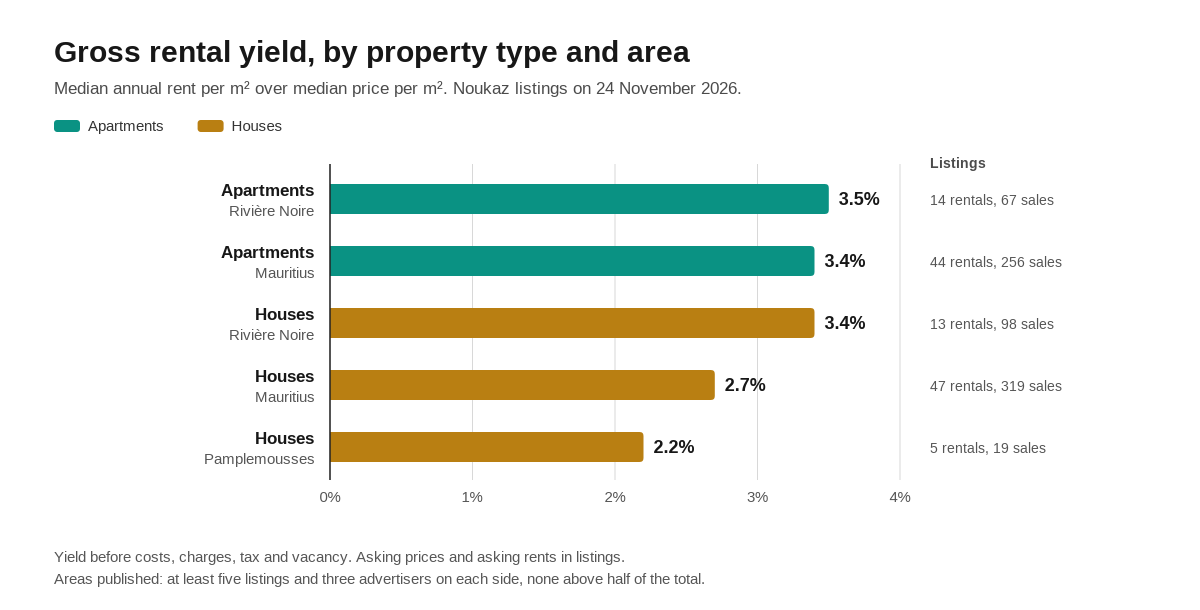
We only publish a figure if, on the rental side and on the sale side alike, it rests on at least five listings, placed by at least three different advertisers, none of whom accounts for more than half of the total. That is why the north around Grand Baie (Rivière du Rempart district), Plaines Wilhems, Moka, Port Louis and the east coast do not appear: on that day, rental listings there were too few or too concentrated with a single advertiser.
What these figures say, and what they do not
They compare asking prices with asking rents. Neither is a signed amount. An asking price is usually a little above the final price; so is an asking rent.
They bring together two different sets of listings. The homes for rent and the homes for sale are not the same homes. Working per square metre corrects for size, not for standard.
They describe Noukaz’s listings, not the whole market. Only five combinations of area and property type pass our filter. The absence of the others does not mean yields are poor there, only that we do not have enough listings to measure them.
They give an order of magnitude. Across these five measures, gross yield runs from 2.2% to 3.5%. For comparison, the Bank of Mauritius’s Key Rate has been 5% since 11 November 2026: if you borrow, compare your loan rate with the gross yield before counting on the rent to cover the repayments. Lending terms are in the home loan guide.
From gross to net: a worked example
Take a 100 m² apartment bought and let at the island’s medians. The costs are those of the scales in force.
| Amount | |
|---|---|
| Purchase price (100 m² at Rs 179,971) | Rs 17,997,100 |
| Registration duty, 5% | Rs 899,855 |
| Notary’s fees, scale plus VAT | Rs 119,296 |
| Total cost of the purchase | Rs 19,016,251 |
| Asking rent (100 m² at Rs 507) | Rs 50,700 a month, or Rs 608,400 a year |
| Gross yield on the price | 3.4% |
| Gross yield on the total cost | 3.2% |
| Agency letting fee, at the cap, VAT included | Rs 55,973 |
| Income tax, if this rent is your only taxable income in Mauritius, with no deduction | Rs 10,840 |
| Left in the year the property is let | Rs 541,587, or 2.8% of the total cost |
This table stops at the costs that a scale can price. What depends on each property still has to come off: service charges, maintenance, insurance, months without a tenant and, if you borrow, interest. Ask the seller and the managing agent (syndic) for those figures before you commit.
Purchase costs are detailed in the guide to duties and taxes and the notary fees guide.
Letting by the year
Residential lettings fall under the Landlord and Tenant Act 1999. Three points for a landlord:
- Furnished lets are treated separately. The Act excludes furnished lettings from its scope: everything then rests on the contract. Put the term, the notice period, the amount of the deposit and the conditions for returning it in writing.
- The deposit usually runs from one to three months' rent. It is held by the landlord: there is no deposit protection scheme.
- Agency fees have been capped since 1 August 2026 at 8% of twelve months' rent for each party, plus 15% VAT. A written contract with the agency is compulsory.
The full sequence, seen from the tenant’s side, is in the long-term rental guide: it is also the list of what a sound landlord’s file should cover.
Letting to tourists
Short lets follow other rules, and they are heavier.
You need a licence. In a communiqué dated 24 January 2023, the Tourism Authority recalls that owners of bungalows, villas, campements and apartments made available for less than twelve months must hold a Tourist Enterprise Licence, issued under the Tourism Authority Act 2006. The communiqué draws no distinction according to how the guest is found: it is the duration that counts. The Authority announces checks carried out with the police. Operating without a licence is an offence under the Tourism Authority Act, punishable by a fine and imprisonment.
The property must meet standards. A self-contained home where tourists cater for themselves, which is neither a hotel nor a guesthouse, falls into the "tourist residence" category. The Authority’s guidelines require, among other things:
- a permit from the local authority (Building and Land Use Permit) and, in a residence, a letter of authorisation from the co-owners' association (syndicat des copropriétaires);
- favourable clearances from the fire and health services;
- an alarm linked to a security company and a safe; CCTV from five rooms up; a standby generator from four bedrooms up;
- bedrooms of at least 10 m² for one person, 12 m² for two and 16 m² for a family.
The application fee is Rs 5,000 and the licence is valid for twelve months. If the investment comes from a non-citizen, clearance from the Ministry of Tourism is added to the file.
You collect a tax. Since 1 October 2025, the Tourist Fee has been 3 euros per tourist per night, from the age of 12. The manager of the accommodation collects it, declares it online every month to the Mauritius Revenue Authority and pays it over before the end of the following month, in euros or US dollars. It is due even if the accommodation has no licence. Residents of Mauritius, Mauritians living abroad, holders of a Premium Visa or a residence permit, and stays in Rodrigues are exempt. Late payment costs a 10% penalty and 1% interest a month.
The guests exist, but they are shared. Mauritius received 1,436,250 tourists in 2025, 3.9% more than in 2024, with an average stay of 11.3 nights. In the first half of 2025, 73.4% of them stayed in a hotel and 9.4% in a tourist residence, according to Statistics Mauritius.
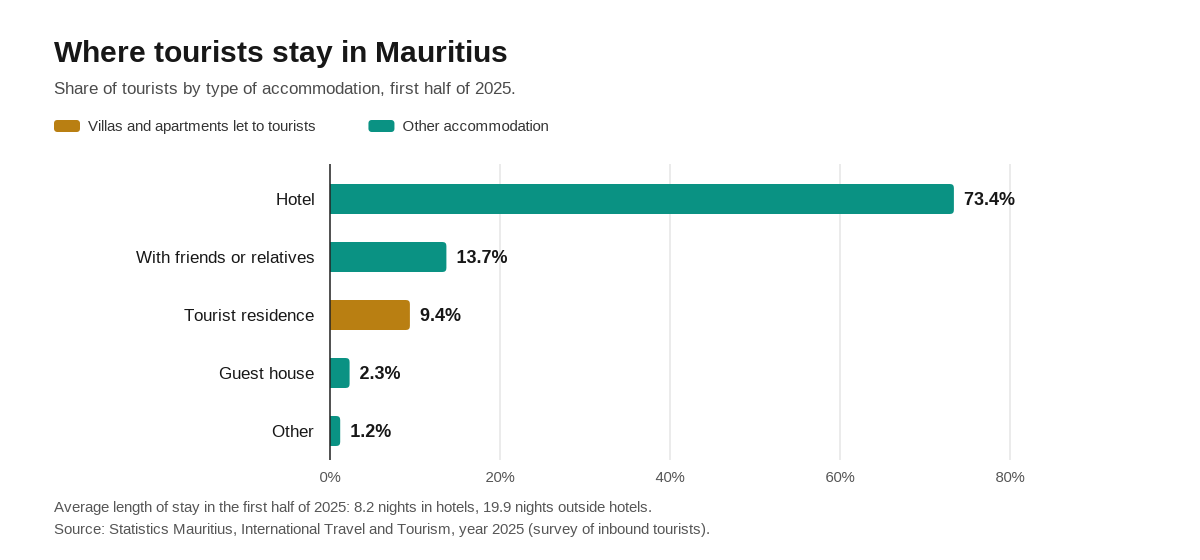
Statistics Mauritius publishes the occupancy rate of hotels (74% of rooms in 2025). We have not found an equivalent public figure for tourist lets. When you are shown a projection of holiday rental income, ask for the property’s actual booking history, month by month, not an average.
If you are a foreigner
A non-citizen can only buy certain properties: those in an approved scheme (PDS, IRS, RES, Smart City, Invest Hotel) or an apartment in a G+2 building priced at Rs 6 million or more. The guide for foreign buyers sets out these routes. For letting, each has its rule:
- In an IRS, RES or PDS scheme, you may let, but through the scheme company or the manager it appoints, under the Economic Development Board’s guidelines. Ask for the management contract before you buy: it sets the commission and how income is shared.
- In the Invest Hotel Scheme, you buy a unit of a hotel, operated by the hotel. You may occupy it 45 days in each period of twelve months; the operator pays you a share of the income.
- For an apartment in a G+2 building, the EDB’s guidelines do not deal with letting. They do prohibit any property speculation.
Two points in common. A property worth more than US$375,000 gives the right to a residence permit for as long as you remain the owner. And Mauritius places no restriction on capital leaving the country: rent and resale proceeds can go back home. To receive rent locally, see the bank account guide.
Tax on rent
Rent is taxable income. It is added to your other taxable income in Mauritius. The scale in force leaves the first Rs 500,000 of chargeable income in the year untaxed, taxes the next band up to Rs 1 million at 10%, then 20%, and 35% above Rs 12 million. Expenses incurred exclusively to produce the income are deductible; private or capital expenses are not.
A non-resident owner is taxed on Mauritian rent. The general rule is that a non-resident pays tax on income from a Mauritian source.
Tax is deducted at source when the tenant is not an individual. A company paying rent deducts 7.5% if the landlord is resident and 10% if not, unless its annual turnover does not exceed Rs 6 million. The deduction is an advance: it is set against your tax for the year, and any excess is refunded. An individual renting a home deducts nothing.
On resale, there is no general capital gains tax in Mauritius. The seller pays land transfer tax, 5% of the price. There is no national property tax either: only five towns levy municipal rates.
Before you buy to let: eight questions
- What rent is actually signed in the building or the area, not just asked?
- How many months has the property stood empty in the last two years?
- What are the service charges, and what do they cover?
- Do the co-ownership rules allow short lets?
- Does the property already have a Tourist Enterprise Licence, and can it be taken over?
- In a scheme, what does the management contract provide: commission, term, exit?
- What is the total cost of the purchase, duty and notary included?
- At what rate are you borrowing, and what is left of the rent once the repayment is made?
Frequently asked questions
What is the rental yield in Mauritius?
From the listings published on Noukaz on 24 November 2026, the gross yield on a long let runs from 2.2% to 3.5% depending on the area and the type of property: 3.4% for apartments across the island, 2.7% for houses.
Where is the yield highest?
Among the areas where we have enough listings to publish a figure, apartments in the Rivière Noire district come first, at 3.5% gross, ahead of houses in the same district (3.4%).
Can you let your property to tourists in Mauritius?
Yes, with a Tourist Enterprise Licence from the Tourism Authority. It is required for bungalows, villas and apartments made available for less than twelve months, and the property has to meet the standards.
What is the Tourist Fee?
A tax of 3 euros per tourist per night, in force since 1 October 2025 outside Rodrigues. The accommodation provider collects it and pays it to the Mauritius Revenue Authority every month.
Is rental income taxed in Mauritius?
Yes. It forms part of chargeable income, taxed at 0% up to Rs 500,000, 10% up to Rs 1 million, 20% above that and 35% above Rs 12 million. If the tenant is a company, it deducts 7.5% at source, or 10% if the landlord is non-resident.
Can a foreigner let the property they bought?
In an IRS, RES or PDS scheme, yes, through the scheme company or its manager. Rent can be repatriated.
Long lets or tourist lets?
A long let takes a lease and little paperwork. A tourist let takes a licence, a property that meets the standards and the collection of the Tourist Fee. Compare the two on recorded income, not on a projection.
Further reading: property for sale, prices by district and how to choose an estate agent.
Sources: listings published on Noukaz on 24 November 2026 (yield calculations); Bank of Mauritius (decision of 11 November 2026); Notaries Act 2008 (scale of fees); Landlord and Tenant Act 1999; 2026 regulations on estate agents' fees; Tourism Authority (Tourist Residence guidelines of 24 February 2022, checklist of 15 May 2025, communiqué of 24 January 2023, guide to the Tourist Enterprise Licence); Mauritius Revenue Authority (Tourist Fee guide of March 2026, Tax Deduction at Source guide of October 2025); Statistics Mauritius (International Travel and Tourism, year 2025); Finance Act 2026; Economic Development Board (guidelines for the schemes and for apartments).
General information, not investment or tax advice. Yields are calculated from listings and do not predict the income of any given property.