
Guides
Opening a Bank Account in Mauritius: Residents, Foreigners, Non-Residents
Opening an account in Mauritius is a formality if you live on the island, takes a little longer for a foreigner settled here on a permit, and becomes a real file for someone who lives abroad. The account is the same. What changes is the set of documents the bank must collect before it opens one: the identity check known as KYC ("know your customer"), which the Mauritius Bankers Association describes as mandatory for all banks.
This guide uses the document lists published by the banks themselves, their minimum deposits, what deposit insurance covers, and where the account fits in when you buy a property. Terms were read on the banks' websites on 24 November 2026. They change: check them before you go.
What the bank asks for, by situation
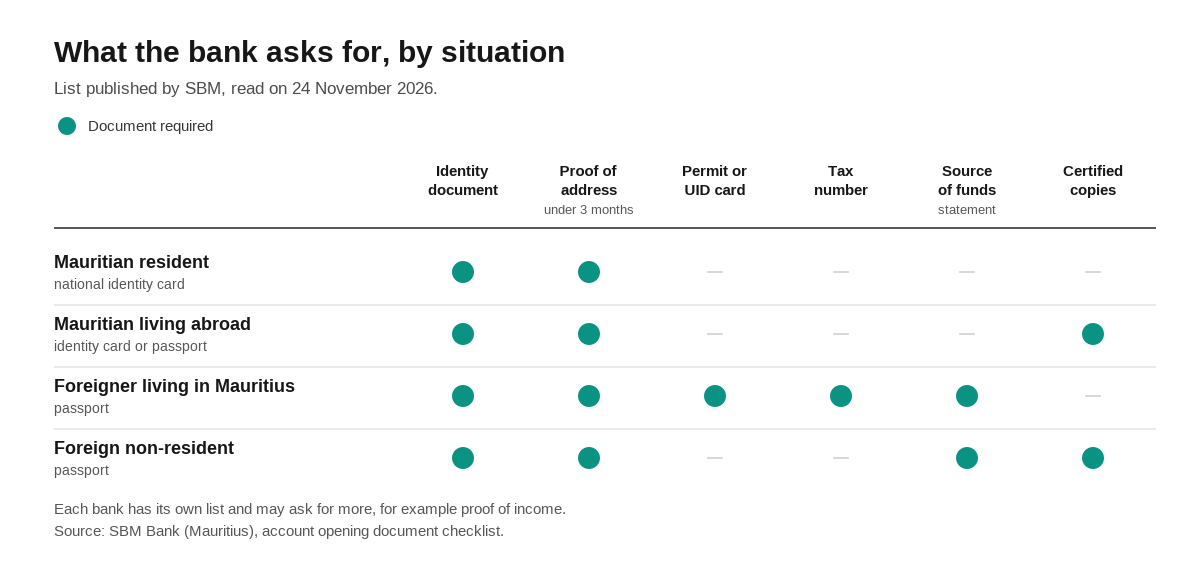
SBM publishes the most detailed list. It separates four situations:
| Your situation | Identity | Address | Also |
|---|---|---|---|
| Mauritian resident | National Identity Card | CEB, CWA or Mauritius Telecom bill less than 3 months old, or a bank statement less than 3 months old | |
| Mauritian living abroad | National Identity Card or Mauritian passport | Utility bill or bank statement less than 3 months old | Certified true copies |
| Foreigner living in Mauritius | Passport | Same as a Mauritian resident | Residence permit, occupation permit or UID card; tax identification number; statement of source of funds |
| Foreign non-resident | Passport | Utility bill or bank statement less than 3 months old | Statement of source of funds; certified true copies |
Each bank has its own list and may ask for more. BCP Bank, for example, adds proof of income (latest payslip, employment certificate or latest income tax notice) and says its list is not exhaustive.
The documents, one by one
Identity. The National Identity Card for a Mauritian, a valid passport for a foreigner. Bring the original: BCP Bank and Absa ask for it.
Address. This is the document that most often holds up a newcomer. Banks ask for an electricity (CEB), water (CWA) or landline (Mauritius Telecom) bill, less than three months old at both SBM and Absa. If the bill is in someone else’s name, MCB asks for an authorisation letter from that person and a copy of their identity card. SBM accepts evidence of the relationship instead, such as a marriage certificate or a valid lease. If you rent, keep your lease to hand: it is what ties your name to the address on the bill.
Permit. A foreigner living in Mauritius shows the document that lets them stay: residence permit, occupation permit or UID card, in SBM’s list. The routes to that permit are compared in our guide to moving to Mauritius.
Tax number and source of funds. SBM asks foreigners for a statement of source of funds: where the money you will deposit comes from, whether salary, savings or the sale of a property. From foreigners who live in Mauritius, it also asks for a tax identification number. Expect to back the statement with documents. Banks may ask for more to check that your transactions match your profile.
If you do not live in Mauritius
You can open an account without living on the island, but the file is heavier. SBM asks a non-resident, Mauritian or foreign, for certified true copies of the documents. The certification must come from a notary, a law firm, a barrister, an attorney or a senior officer of an embassy, in the country where you are. You add the certifier’s own identity document, with the signature visible, and evidence that they are registered with their professional body. A document that is in neither English nor French needs a translation, with the translator’s signature and contact details.
Two practical consequences. Start before you travel: gathering certified copies takes time. And keep a paper trail for the source of your funds, such as the deed of sale of a property or savings statements. It is the one question a non-resident will not avoid.
Which account, and at what cost
Banks offer three families of accounts: the current account, which usually bears no interest and comes with a card and a cheque book; the savings account, which usually bears interest; and the fixed deposit, locked for a set period. Accounts are held in rupees. MCB, Absa and AfrAsia also offer foreign currency accounts.
Some reference points from the banks' websites:
| Bank | Account | To open it | Fees |
|---|---|---|---|
| MCB | Current account in rupees | Minimum deposit of Rs 1,000 | Rs 25 a month, plus VAT; Rs 6 per cheque sheet |
| MCB | Foreign currency account | Pound sterling, US dollar, euro, Australian dollar, rand; other currencies on request | |
| Absa | Digi account, in rupees | No minimum balance | No monthly fee; a branch visit is charged Rs 86.25 including VAT |
| Absa | Foreign currency account | Euro, pound sterling, US dollar, rand, Australian dollar; no minimum opening balance | Rs 86.25 a month; no interest |
| AfrAsia | Current or savings account in rupees | Rs 10,000 | No monthly charge on the savings account |
This table gives orders of magnitude, not a comparison. Also compare the price of international transfers and the exchange rate applied, which are not shown here.
Online or at a branch
A resident can apply without leaving home. Absa opens its Digi account online for Mauritian citizens and for expatriates living in Mauritius with a valid residence permit: you must be 18 or over, be tax resident in Mauritius only, and pass a video check of about thirty seconds. At MCB, a customer who already uses Internet Banking or the Juice app can apply for a foreign currency account from the app.
At MCB and BCP Bank, a first account is opened by appointment: MCB takes bookings by phone, and BCP Bank receives customers at its business centre in Port Louis and asks all holders of a joint account to be present, with their originals.
Most of the websites we read give no opening time. A file that is complete on the first day is what saves the most time.
Are your deposits protected?
Yes, up to a limit. Since 14 June 2024, a deposit insurance scheme has covered individuals' accounts up to Rs 300,000 per depositor per institution, principal and interest included. Protection is automatic: there is nothing to apply for. It covers current, savings and fixed deposit accounts, in rupees or in foreign currency, at the thirteen banks that were members of the scheme at the end of May 2026 and at six non-bank deposit-taking institutions. On a joint account, each holder is covered for their share.
Two limits to know. The scheme covers residents only: a non-resident’s deposits are excluded, as are companies' deposits. And a loan from the same institution is deducted from your deposits before any payout.
The account and buying a property
In a sale, the money never goes straight to the seller. The deposit paid at the preliminary agreement, usually around 10%, then the balance and the duties, all go through the notary’s account. The steps are set out in the buying guide.
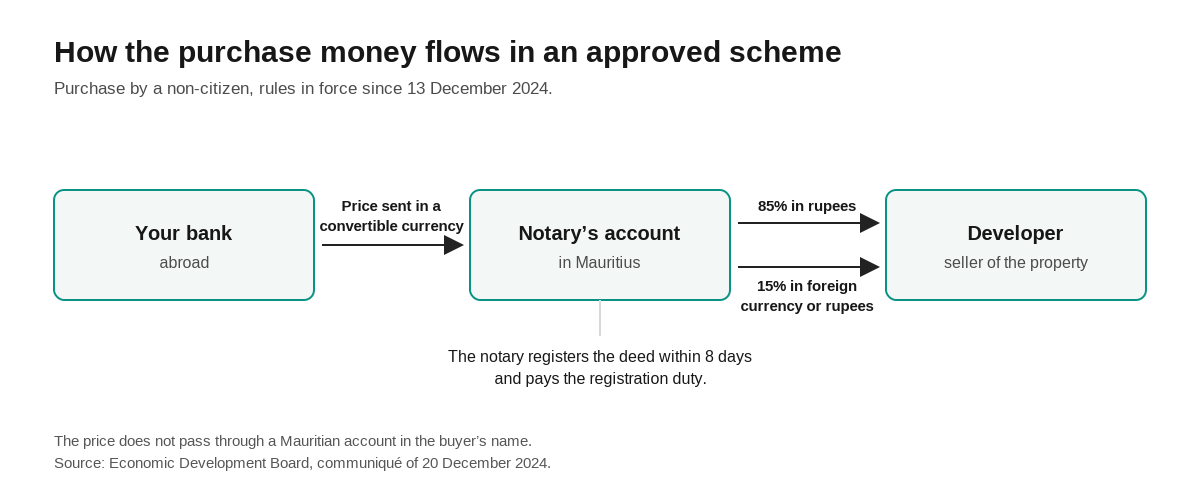
For a foreign buyer, the route is fixed by the rules. In an approved scheme (PDS, IRS, RES, Smart City, Invest Hotel), since 13 December 2024 the price must be transferred from abroad, in a convertible currency, to the notary’s account. The notary then pays the developer 85% of the price in rupees and the rest in foreign currency or rupees, registers the deed within eight days and pays the registration duty. The price does not pass through a Mauritian account in your name.
Two more points for a foreign buyer:
- Apartment in a G+2 building. The application for authorisation filed with the Economic Development Board must include a letter from a recognised bank, local or international, showing that you have the funds. The guide for foreign buyers describes this route.
- Local loan. If the price exceeds USD 750,000, the first USD 750,000 must come from abroad. The balance may be borrowed in rupees from a Mauritian bank and is repaid in a convertible currency. See the home loan guide.
The Mauritian account becomes useful after the purchase: service charges, water and electricity bills, rent received if you let the property. Mauritius places no restriction on capital leaving the country: rent and resale proceeds can go back home.
After the account is open
The check does not stop on the day the account opens. The bank may ask you again for up-to-date documents, and you must tell it of any material change: address, residence status, occupation. A file left incomplete can lead to transactions being stopped, then to the account being closed. If you leave Mauritius, tell the bank: a non-resident’s account does not follow the same rules, starting with deposit insurance.
Frequently asked questions
Can a foreigner open a bank account in Mauritius?
Yes. A foreigner living in Mauritius shows a passport, proof of address less than three months old and a permit; SBM also asks for a tax identification number and a statement of source of funds. A foreign non-resident supplies certified true copies of the documents.
Can you open a bank account in Mauritius without living there?
Yes, with a heavier file. SBM asks a non-resident for copies certified by a notary, a lawyer or a senior embassy officer in the country where they are, proof of address less than three months old and a statement of source of funds.
What documents do you need to open a bank account in Mauritius?
An identity document (National Identity Card or passport) and recent proof of address: a CEB, CWA or Mauritius Telecom bill, or a bank statement. Depending on the bank and your situation, add your permit, proof of income, tax number and source of funds.
What is the minimum deposit?
It depends on the bank and the account: Rs 1,000 for MCB’s current account, Rs 10,000 at AfrAsia, no minimum balance for Absa’s Digi account (as read on 24 November 2026).
How long does it take?
Most of the banks we read give no opening time. A resident can apply online at Absa; a non-resident should allow for the time needed to have documents certified and to answer questions on the source of funds.
Are bank deposits protected in Mauritius?
Up to Rs 300,000 per depositor per institution, for resident individuals, in rupees or foreign currency. Deposits of non-residents and of companies are not covered.
Do you need a Mauritian bank account to buy property in Mauritius?
Not to pay the price in an approved scheme: a non-citizen buyer transfers the funds from abroad, in foreign currency, to the notary’s account. The local account is then used for service charges, bills and rent.
Looking for a property? Browse property for sale and the schemes open to foreign buyers.
Sources: document lists and terms published by SBM Bank (Mauritius), MCB, Absa Bank (Mauritius), BCP Bank (Mauritius) and AfrAsia Bank, read on 24 November 2026; Mauritius Bankers Association (KYC); Bank of Mauritius and Mauritius Deposit Insurance Corporation (deposit insurance, list of members at end-May 2026); Economic Development Board (payment rules of 13 December 2024, scheme and apartment guidelines).
General information, not financial or legal advice. Banks' terms change: check them with the bank before opening an account.