
Guides
Can Foreigners Buy Property in Mauritius? Every Route, Explained
Yes — foreigners can buy property in Mauritius, and thousands do every year. But not any property, and not any way you like. The law channels non-citizens through a small number of well-marked doors, and everything outside those doors is off the table.
The good news: the doors are wider than most people think, the process is handled in English and French, and Mauritius remains one of the few places where a property purchase can carry a residence permit for your whole family. The complication: the tax rules moved twice in twelve months. A doubling of the buyer’s registration duty was voted in 2025, then called off in 2026 before it ever bit — and most of what you’ll read online is still working from the wrong version.
Here’s the full picture, route by route.

The short answer, by property type
| You want to buy… | Can you? | The route |
|---|---|---|
| A villa or apartment in a resort development | Yes | Approved schemes (PDS, IRS, RES, Smart City, Invest Hotel) |
| An apartment in an ordinary building | Yes, from Rs 6 million | The “G+2” route |
| A standalone house outside the schemes | Only with special authorisation | Rarely granted |
| Bare or agricultural land | Effectively no | Serviced plots inside some schemes are the exception |
Everything runs through the Economic Development Board (EDB), which vets the buyer and the transaction. Your notary files the application; you mostly sign things.
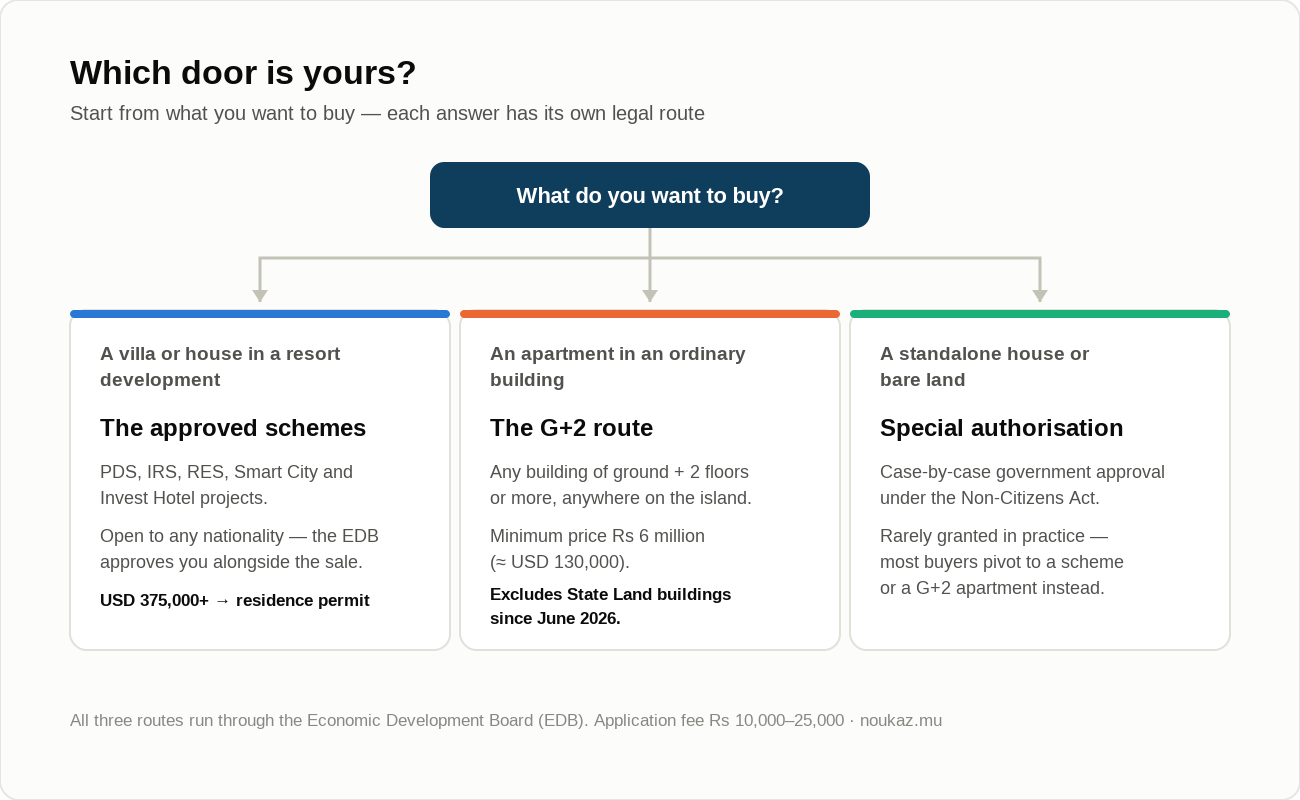
Route 1 — The approved schemes
This is the classic route: developments built specifically so that non-citizens can own in Mauritius with full, permanent title.
The acronyms are a small history lesson. IRS (Integrated Resort Scheme) came first in 2002 — large luxury villa estates with golf courses and marinas. RES (Real Estate Scheme) followed as its smaller, less regimented sibling. Both stopped accepting new projects in 2015, when the PDS (Property Development Scheme) replaced them — but IRS and RES villas still trade on the resale market, so you’ll meet all three acronyms in listings. Add Smart City projects (mixed-use developments like Moka or Beau Plan, where residences sit alongside offices and schools) and the Invest Hotel Scheme (you buy a hotel room or unit, the operator rents it out), and you have the complete family.
What buying in a scheme actually gets you:
- Certainty. The development is pre-approved for foreign ownership; your EDB application is a formality rather than a gamble.
- Off-plan protection. Most scheme sales are off-plan (VEFA, inherited from French law), which means staged payments and a completion guarantee — the developer’s bank must finish the building if the developer can’t.
- Residency, at the right price. Spend USD 375,000 or more and the purchase carries a residence permit — more on that below.
The trade-off is price. Scheme properties are priced for an international market, mostly in dollars or euros, and a premium of 30–50% over comparable “local-market” property is normal. You’re paying for the legal wrapper, the amenities, and the rental machinery. Whether that’s worth it depends on what you’re optimising for — we’ve detailed each regime in our guide to PDS, IRS, RES and Smart City.
Route 2 — The G+2 apartment (the door most people miss)
Since 2016, a non-citizen can buy any apartment in a building of at least a ground floor plus two storeys, anywhere in Mauritius, for a minimum of Rs 6 million — roughly USD 130,000. No scheme, no resort, no golf course. An ordinary apartment in Quatre Bornes, Flic en Flac or Grand Baie qualifies, as long as the building is tall enough and the price clears the bar.
This is the most underrated path into Mauritian property. It opens the entire local apartment market — where prices follow Mauritian incomes rather than international buyers’ budgets — at less than half the schemes’ residency threshold. The catch: below USD 375,000 there’s no residence permit attached, and the building must genuinely have two floors above the ground floor (the G+2 test).
One door closed in June 2026. The 2026-27 budget stopped the government granting new leases that allow apartments built on State Land or Pas Géométriques — the coastal strip and other state-owned land — to be sold to non-citizens. Owners who already hold such an apartment, and leases already approved, are not affected; but anyone selling one of those units now pays a 10% special levy, unless the reservation contract was signed before 19 June 2026. In practice this closes a narrow seafront niche and leaves the G+2 route on privately owned land exactly as it was. Worth one question to your notary early: is this building on state land?
You still file through the EDB, your notary still handles it, and the apartment is still yours in full ownership. Browse apartments for sale with this filter in mind and Rs 6M suddenly goes further than the glossy brochures suggest.
Route 3 — Everything else: special authorisation
A standalone house on its own plot, outside any scheme? Bare land to build on? For a non-citizen, these need case-by-case authorisation from the government under the Non-Citizens (Property Restriction) Act — the 1975 law that structures this whole subject. Authorisations of this kind are granted sparingly, usually for particular personal or economic circumstances, and no notary will let you sign a compromis without that certainty first.
Two practical notes. Agricultural land is effectively closed to foreign buyers — don’t let anyone convince you otherwise, whatever creative structure they propose. And if your dream really is a standalone villa with a garden, that’s precisely what the PDS schemes exist to sell you, with serviced residential plots inside some smart cities as the build-it-yourself variant.
What it costs — and the 10% that was called off
This is where almost every guide you’ll find online is now wrong, so it’s worth walking through slowly.
In August 2025, the Finance Act 2025 voted a doubling of the registration duty paid by non-citizens buying residential property under the EDB schemes: 5% to 10%, due to take effect on 1 July 2026. That measure was announced everywhere, and dozens of articles — written in good faith — still describe it as the law.
It was called off before it ever bit. The June 2026 budget announced a review of these duties “to maintain market attractiveness”, and the Finance Bill 2026, introduced in Parliament on 28 July 2026, repeals the increase outright. The general rate of 5% continues to apply to the buyer.
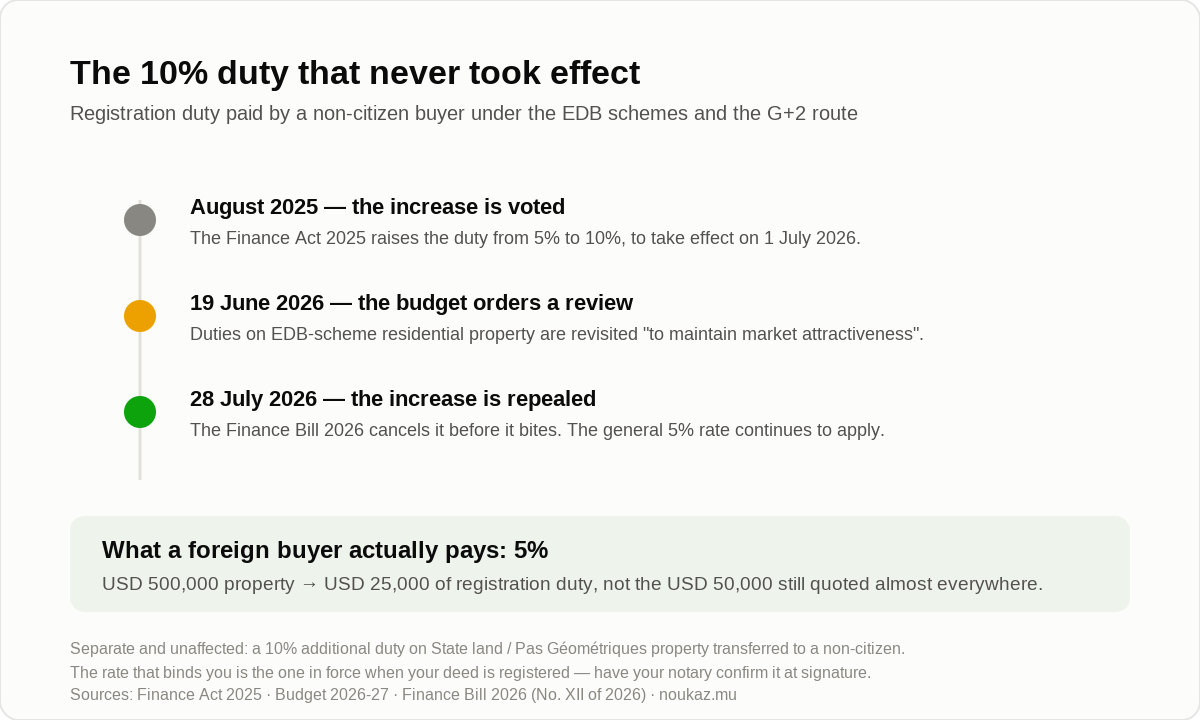
So, as a foreign buyer, budget 5% registration duty — the same rate a Mauritian pays. One caveat worth respecting: the repeal takes effect on the date the Act is gazetted, and in early August 2026 that publication was still pending. The rate that binds you is the one in force when your deed is registered, so have your notary confirm it in writing at signature rather than relying on any article, including this one.
The seller’s side is a separate tax. Registration duty (yours) and land transfer tax (the seller’s) are two different obligations under two different laws, which is why you’ll hear people say “the 10% is only for the seller”. The 2025 Act raised both; the Finance Act 2026 repeals both, so the seller is back to 5% as well. It doesn’t land on your bill directly, but it shapes what a seller will accept on price. The two taxes are set out in full in our guide to registration duty and land transfer tax.
One 10% that is real and new. The Finance Bill 2026 creates an additional duty of 10% on any deed transferring a residential property located on State land or Pas Géométriques to a non-citizen (Land (Duties and Taxes) Act, new s. 4(11); Seventh Schedule, Part IV). It doesn’t apply where a pre-sale agreement was signed before a notary prior to 19 June 2026. This is the companion measure to the closure described earlier — one more reason to ask early whether the building you’re eyeing sits on state land.
On top of the duty, budget for:
- Notary fees on the statutory sliding scale (roughly 0.5–1% on foreign-buyer price ranges, plus 15% VAT) — the same scale as for Mauritian buyers, detailed here.
- The EDB application fee: Rs 10,000–25,000 depending on the route, non-refundable.
- No general capital gains tax when you sell — a structural advantage the 2025 budget debated and left intact. Mauritius also has no national annual property tax on homes; modest municipal rates apply inside the five towns.
Concretely, on a USD 500,000 villa: USD 25,000 of registration duty, not the USD 50,000 half the internet will quote you.
Can you get a mortgage as a non-resident?
Yes, and more easily than in many countries. Mauritian banks lend to non-residents, typically financing up to about 70% of the property’s value — so plan a deposit of 30% or so — over terms that commonly run up to 15 years. Rates follow the currency you borrow in: borrow in euros and the pricing tracks European benchmarks, borrow in rupees and it tracks local rates. Buying off-plan in a scheme helps rather than hurts, because the VEFA completion guarantee gives the bank security it understands.
Expect the paperwork to focus on your foreign income: payslips, tax returns, and proof of regular transfers. Our home loan guide covers the bank-by-bank details.
Property and residency: two different things
This is the point most first-time buyers mix up, so let’s be precise.
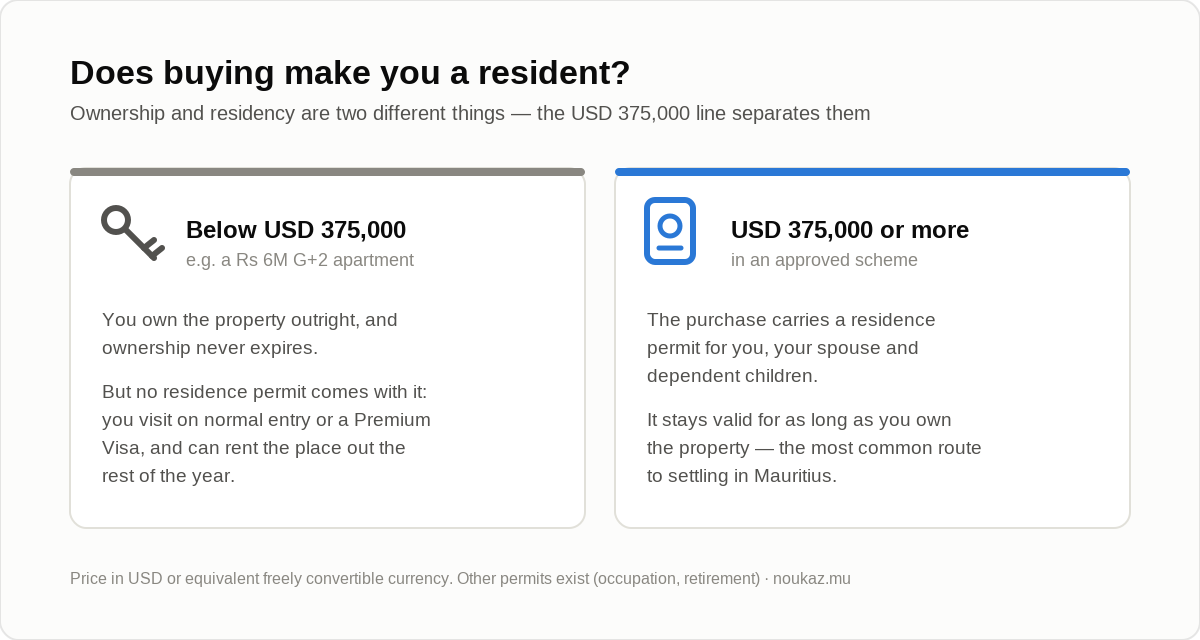
Buying doesn’t automatically make you a resident. A Rs 6M G+2 apartment makes you an owner, full stop — you’ll visit on ordinary entry (visa-free for most nationalities) or a long-stay Premium Visa, and you can rent the place out the rest of the year.
At USD 375,000 or more, in a scheme, residency comes with the deed. The residence permit covers you, your spouse and dependent children, and remains valid for as long as you own the property. It’s the most common route to actually settling in Mauritius, and the threshold is per property, not per person. Alternatives exist for people below the threshold — occupation permits for professionals, a retirement permit at 50+ — which we cover in our moving to Mauritius guide.
A word on the golden visa announced in the June 2026 budget, because it’s already being mis-sold: it grants a 20-year permanent residence permit for an investment of USD 1 million — but in business sectors like fintech, AI, biotech and renewables, and it explicitly excludes buying residential property. It’s a different product for a different buyer. If your plan is a house, the USD 375,000 scheme route remains the one that matters.
The buying process — same road, one extra lane
Everything in our step-by-step buying guide applies to you: the notary-drafted compromis de vente, the ~10% deposit in escrow, the title checks, the deed. The foreign buyer’s version adds one parallel track: the EDB application, filed by your notary with your passport, proof of funds and the sale details. Approval typically lands within a few weeks and slots into the normal six-to-ten-week gap between compromis and deed — make sure your compromis includes a suspensive clause so that if the EDB says no, your deposit comes back.
One genuinely useful habit: insist on the compromis being conditional on both your financing and your EDB approval. Belt and braces cost nothing at drafting time.
Does nationality matter?
For Mauritius, no — the rules above apply identically whether you’re French, South African, Indian, German or anything else. What changes is your side of the journey: South Africans navigate exchange-control allowances when moving funds out, Indian residents contend with the LRS remittance ceiling, Europeans mostly just wire the money. See what changes by nationality for the full country-by-country breakdown.
Frequently asked questions
Can a foreigner buy land in Mauritius?
Bare and agricultural land, no — with rare special authorisations as the exception. The workable version is a serviced residential plot inside an approved scheme (some smart cities offer them), where you buy the plot and build within the project’s rules.
What is the minimum price for a foreigner to buy an apartment in Mauritius?
Rs 6 million, in a building of at least ground plus two floors. Below that price, or in a smaller building, the purchase can’t be approved — however willing the seller. Since June 2026 there’s one carve-out: apartments built on State Land or Pas Géométriques are no longer opened to non-citizens through new leases.
Do I get permanent residency if I buy property in Mauritius?
Buying at USD 375,000+ in an approved scheme gives you (and your spouse and dependents) a residence permit valid for as long as you own. It’s tied to ownership rather than permanent in itself — sell the property, lose the permit.
How much tax does a foreigner pay when buying property in Mauritius?
Registration duty of 5% of the price, paid by the buyer — the same rate a Mauritian pays. Add notary fees on the statutory scale (+15% VAT) and an EDB application fee of Rs 10,000–25,000. There’s no national annual property tax on homes (modest municipal rates apply inside the five towns) and no general capital gains tax.
Isn’t the registration duty 10% for foreigners since July 2026?
No. The Finance Act 2025 legislated an increase from 5% to 10% due on 1 July 2026, but the Finance Bill 2026 introduced in Parliament on 28 July 2026 repeals it, and the general 5% rate continues to apply to the buyer. Many guides published earlier in 2026 still quote the 10%. Ask your notary to confirm the rate in force on the day your deed is registered.
Is the 10% paid by the buyer or the seller?
The buyer’s registration duty and the seller’s land transfer tax are separate taxes under separate laws — which is why you’ll hear that “the 10% is only for the seller”. After the 2026 repeal both sides return to 5%. Separately, a real 10% additional duty now applies to deeds transferring residential property on State land or Pas Géométriques to a non-citizen.
Can South Africans and Indians buy property in Mauritius?
Yes — the Mauritian rules are nationality-blind. The constraints come from home: exchange-control approvals for South Africans, the LRS remittance ceiling for Indian residents. Both are manageable and routinely done.
Get the whole thing as a PDF. Everything in this guide, plus the five others in the series, in one 26-page ebook — Buying Property in Mauritius as a Foreigner. Download it free.
The next step is seeing what your budget buys: browse property for sale in Mauritius — every Noukaz listing states clearly whether it’s open to foreign buyers, so you never fall for the wrong house.
General information, not legal or immigration advice. Figures reflect the rules in force in August 2026; your notary confirms the exact position for your transaction.