
Guides
How to Choose an Estate Agent in Mauritius
Until this year, choosing an estate agent in Mauritius came down to word of mouth and a good first impression. Since 1 August 2026 it also comes with rules. Agents who deal in sales must be registered with the Real Estate Agent Authority, and the regulations that arrived with registration spell out what an agent owes a client: a written contract, a fee capped by regulation, a code of conduct, a complaints procedure.
Those rules double as a checklist. This guide uses them to answer the practical question — which agency, and on what terms — whether you are selling, buying, letting or renting.
The first filter, whether the agent is registered at all, has its own page: how to check an estate agent’s registration. Everything below assumes they are, or that their application has been filed.

Start with the job, not the agency
"A good agency" means little on its own. A villa in Grand Baie, a flat to let in Ebène, a scheme apartment bought from abroad and a plot of agricultural land are four different jobs, and the agency that is right for one is often wrong for another.
Before comparing anyone, write down three things:
- What you are dealing in: house, apartment, land, commercial.
- Where: the district, ideally the town. Most agencies are strong in one part of the island and merely present in the rest.
- For whom: a resident buyer, a foreign buyer who needs an approved scheme, a tenant, a landlord.
The third point matters most for foreign buyers. Property under the PDS, IRS, RES or Smart City schemes is usually sold by or for the developer, and the agent who shows it to you is often paid by the developer. That is normal, but it tells you whose interest the agent represents, and it is worth knowing before you rely on their advice. The scheme guide explains what each scheme allows.
Look at what they actually have on the market
An agency’s current listings say more about it than its "about us" page: which areas it covers, which property types, which price range, sale or rent.
On Noukaz, every agency present on the site has a page listing its properties for sale and to rent, and town pages show the agencies active in the town. The directory of estate agents lists estate agencies operating in Mauritius, with those present on Noukaz linked to their page.
Then read the listings as a sample of the agency’s work. Is the price shown? The surface? The real locality, rather than "close to the beach"? Are the photos recent, and is the property still available when you ask? An agency that keeps its listings accurate is likely to keep you informed as well.
One new check costs nothing. Under the 2026 regulations, an advertisement by a registered agent must show the agent’s full name and registration number. An agency whose application is still being processed may not have a number yet, and agents who deal only in rentals are not yet required to register. But a sales advertisement that shows neither is a question worth asking.
Test them before you sign
Send a question about one of their listings and watch what comes back: how long the answer takes, and whether it actually answers the question. It is the cheapest test there is, and it says a good deal about the rest of the relationship.
If you are selling, ask each agency you are considering for a price, with the comparable properties behind it. Be wary of the agency that quotes the highest figure: an inflated price wins a mandate, not a buyer, and the property then sits on the market until the price comes down. The property price barometer gives median prices by district and property type wherever there is enough data, a useful check on any figure you are given.
If you are buying, ask the questions you will need answered anyway: whether a plot is part of an approved morcellement, whether a building permit has been issued for an off-plan project, what the monthly charges are in a residence. Notice who answers precisely and who answers vaguely.
The written contract: what it must say
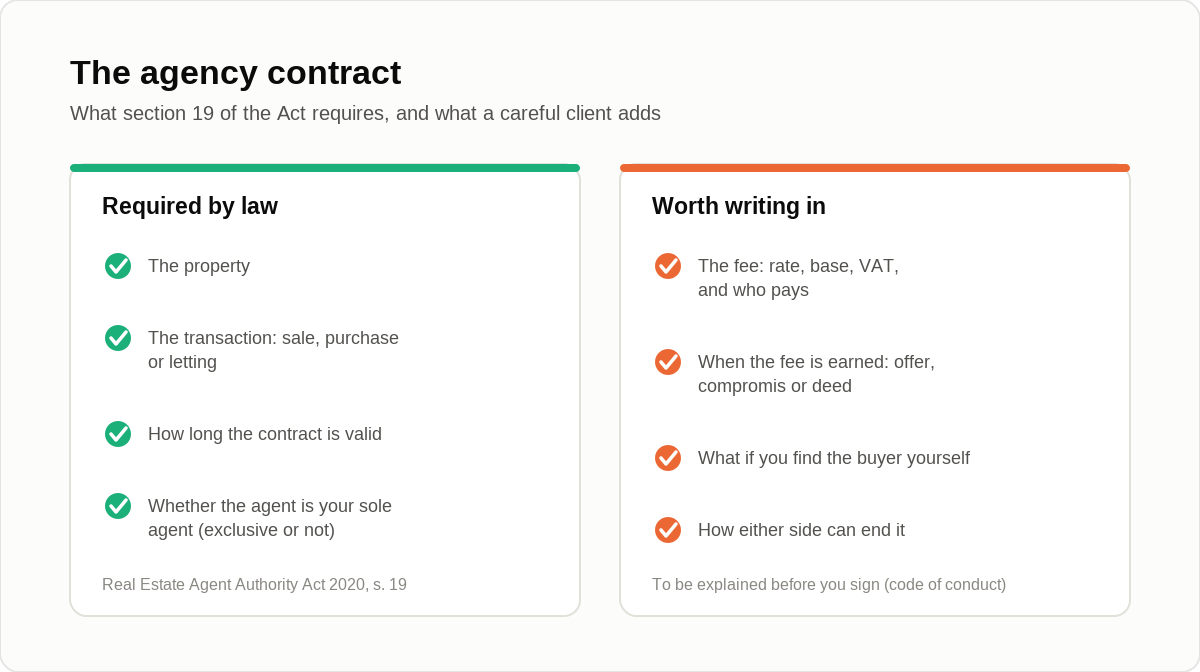
The Real Estate Agent Authority Act 2020 is blunt on this point. Under section 19, an agent may not carry out a transaction on a client’s behalf without a written contract between them. The contract must:
- identify the property and the transaction (sale, purchase, letting);
- state its period of validity;
- say whether the agent is your sole agent, in other words whether the mandate is exclusive.
The code of conduct adds that, before you sign, the agent must explain the commission structure, any marketing expenses and your obligations under the contract, and must not impose unreasonable conditions.
The Act does not list everything a careful client adds. These are worth writing in:
- the fee: the rate, the amount it is calculated on, whether VAT is included, and who pays;
- the moment it is earned: an introduction, an accepted offer, the compromis or the final deed. These are four different moments, and the gap between them is where disputes start;
- what happens if you find a buyer yourself;
- how either side can end the contract, and with what notice.
Exclusive or not
Because the contract must say whether the agent is your sole agent, you will have to choose.
An exclusive mandate gives one agency the job for a fixed period. In return you can expect more from them: better photos, a single consistent price wherever the property appears, regular reports. The cost is that you are tied for the period, so keep it short and renewable rather than open-ended.
A non-exclusive mandate lets several agencies offer the property at once. It widens the net, but buyers notice when the same house appears three times with three prices, and no agency has much reason to invest in marketing a property it may not be the one to sell.
Either way, nobody may market your property without your agreement. Under the Act, an agent who claims authority to act for an owner without the owner’s consent commits professional misconduct, and so does one who uses another agent’s photographs or descriptions to win business. If you find your property advertised by an agency you never signed with, that is a matter for the Authority.
What it costs
The fee is no longer whatever the market will bear. Section 20 of the Act makes it a percentage of the value of the transaction, and the Real Estate Agent Authority (Transaction Fees) Regulations 2026, in force since 1 August 2026, set the ceilings:
| Transaction | Maximum, for each side | On top |
|---|---|---|
| Sale or purchase | 2% of the price from the seller, and 2% from the buyer | VAT at 15% |
| Long let | 8% of twelve months' rent from the landlord, and 8% from the tenant | VAT at 15% |
| Shorter let | 8% of the total rent for the period, from each side | VAT at 15% |
These are ceilings, not set rates: the fee can be negotiated down, and the contract says what you actually pay. On a Rs 10 million sale, the most an agent can charge the seller is Rs 200,000 plus Rs 30,000 of VAT, and the same again for the buyer. On a long let at Rs 40,000 a month, the most is Rs 38,400, slightly less than a month’s rent, plus Rs 5,760 of VAT, from each side.
Two practical points. An agent may charge separately for advice or services the Act does not cover, so ask whether anything comes on top of the fee, and get the answer in writing. And on a new development sold by the developer, the agency is normally paid by the developer, not by the buyer. If you are buying a resale, ask before the first viewing whether the agency will charge you as well as the seller, and how much.
Whose side is the agent on?
Your agent works for whoever signed the contract with them. Things get delicate when one agency deals with both sides of the same sale. The Act allows it only with the written consent of the parties and disclosure to the client; acting as a dual agent without them is professional misconduct. So is acquiring an interest in a property listed with them without fully disclosing it to the owner, or taking an undisclosed commission or rebate on a property they manage.
One question covers all of it: is anyone else paying you on this transaction? Ask it, and ask for the answer in writing.
Money: what goes through the agent, and what does not
On a purchase, the deposit paid at the compromis, usually around 10%, is held by the notary, not by the agency (see the buying guide). Never pay a deposit into an agent’s personal account. If anyone asks for money before a compromis exists, find out who receives it, into which account, and on what written terms.
Where an agent does handle client money, the Act requires accounts that show it clearly and separately, kept for seven years after the transaction.
Expect, too, to be asked for identity documents and the source of your funds. That is not the agent being nosy: estate agents are bound by the anti-money-laundering rules described in the AML/CFT guide.
What the code of conduct gives you
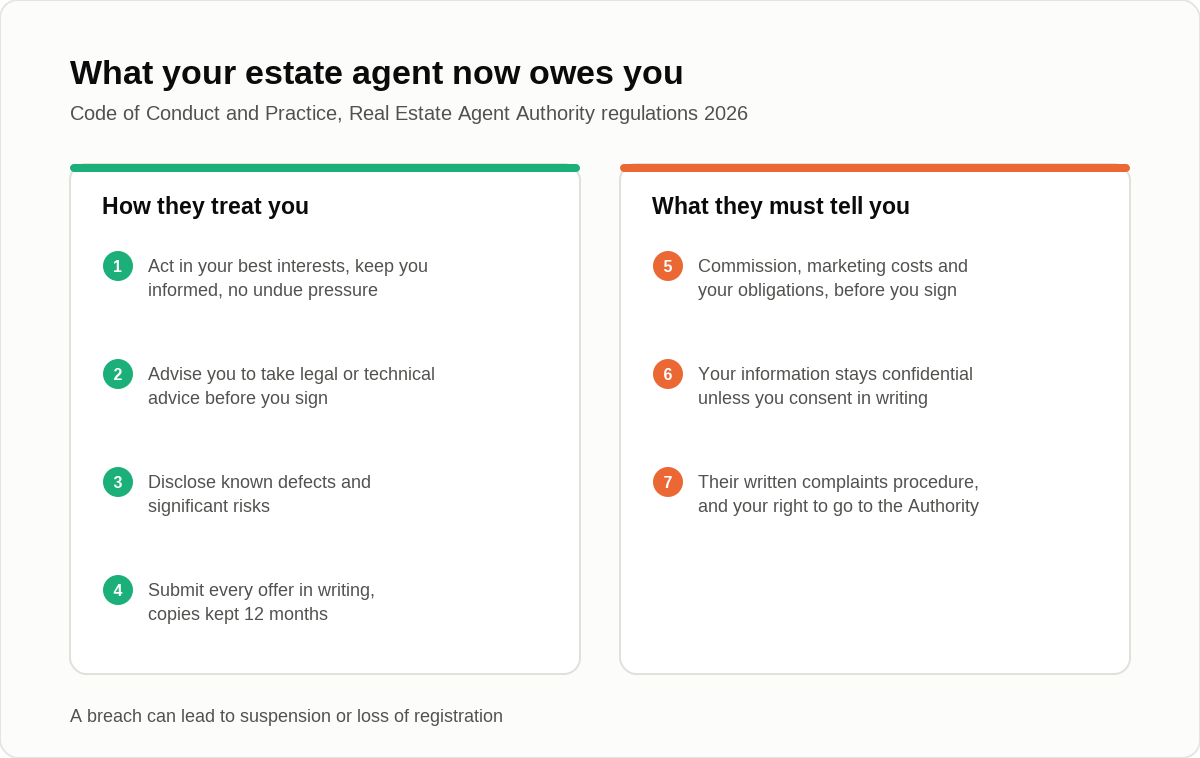
The Code of Conduct and Practice set out in the 2026 regulations binds every registered agent, and a breach can lead to suspension or loss of registration. It must be displayed at the agency’s premises and on its website. Among other things, your agent must:
- act in your best interests, keep you informed and not put you under undue pressure;
- advise you to take legal or technical advice before you sign anything;
- disclose known defects and significant risks;
- submit every offer to you in writing, and keep copies for at least 12 months;
- explain commission, marketing expenses and your obligations before you sign;
- keep your information confidential;
- keep a written complaints procedure, tell you about it, and tell you that you can go to the Authority directly.
Red flags
- No written contract, or one with no end date.
- Pressure to sign, or to pay, "today".
- A deposit to be paid to the agency, or into a personal account.
- A valuation far above every comparable, the classic way to win a mandate.
- No registration number, and no straight answer when you ask for it.
- A fee "to be agreed later", or one above the legal ceiling.
- Your own property advertised by an agency you never signed with.
If something goes wrong
Start with the agency’s own complaints procedure: registered agents must keep one in writing, tell you about it, and notify the Authority of any complaint made against them within ten working days. If that gets you nowhere, you can complain directly to the Real Estate Agent Authority, which can investigate professional misconduct and bring it before a disciplinary committee. And if you and the agent both agree, a dispute over the contract itself can be referred to the Authority to settle.
The notary is the other professional in every transaction (how to find one), and it costs nothing to mention which agency is involved.
Questions to ask before you sign
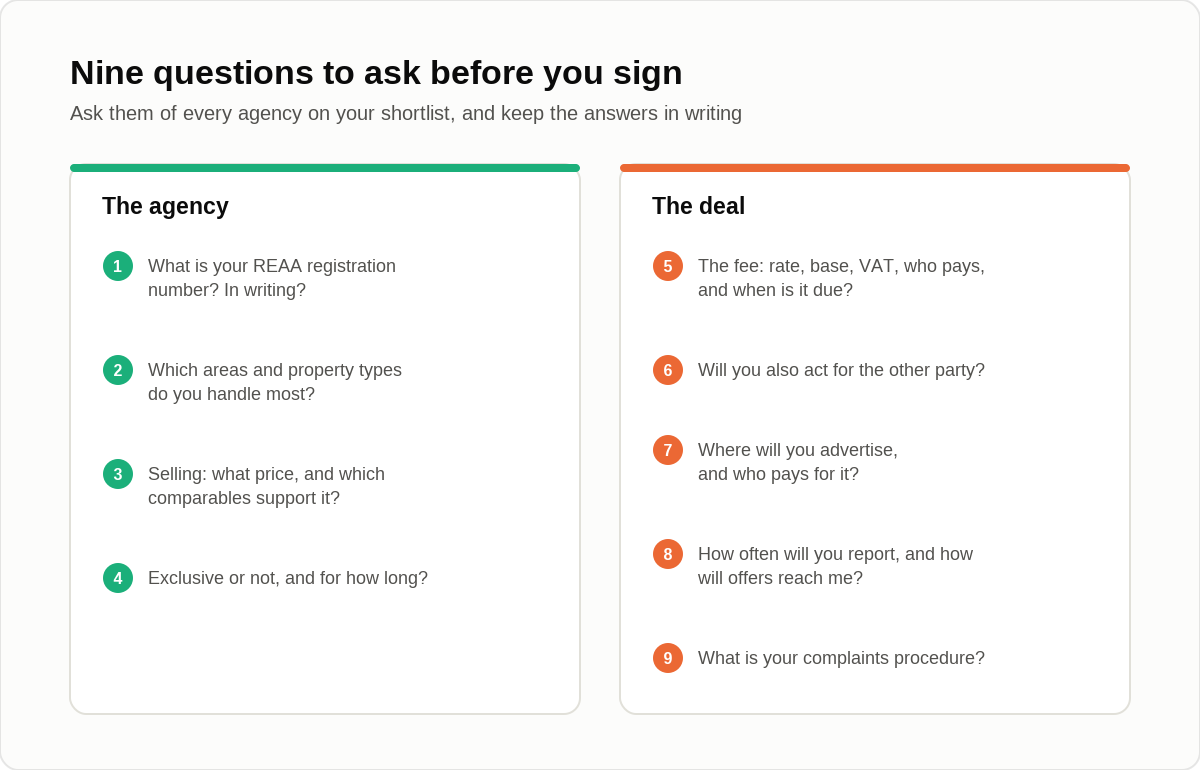
- What is your REAA registration number? Can I have it in writing?
- Which areas and property types do you handle most?
- If I am selling: what price do you recommend, and which comparables support it?
- Exclusive or not, and for how long?
- What is the fee: the rate, the base, VAT, who pays, and when is it due?
- Will you also be acting for the other party?
- Where will you advertise the property, and who pays for it?
- How often will you report to me, and how will offers reach me?
- What is your complaints procedure?
Frequently asked questions
How do I choose an estate agent in Mauritius?
Start from the job: the type of property, the area, and whether you are selling, buying or letting. Shortlist agencies whose current listings match it, check their registration with the Real Estate Agent Authority, test how they answer a question, and compare the written contracts they propose before you sign.
How much do estate agents charge in Mauritius?
Since 1 August 2026, the Real Estate Agent Authority (Transaction Fees) Regulations 2026 cap the fee at 2% of the price from the seller and 2% from the buyer on a sale, and at 8% of twelve months' rent from the landlord and from the tenant on a long let, plus 15% VAT. These are maximums: the fee can be negotiated down.
Who pays the estate agent in Mauritius?
It depends on the contract. The regulations cap what each side can be charged: up to 2% each for the seller and the buyer on a sale, and up to 8% of a year’s rent each for the landlord and the tenant on a long let. On a new development sold by the developer, the agency is normally paid by the developer, not by the buyer.
Does an estate agent need a written contract in Mauritius?
Yes. Under section 19 of the Real Estate Agent Authority Act 2020, an agent may not carry out a transaction for a client without a written contract that identifies the property and the transaction, states its period of validity and says whether the agent is the client’s sole agent.
Should I give an agency an exclusive mandate?
It depends on the property and on the agency. An exclusive mandate usually buys more effort and a single consistent price; a non-exclusive one widens the net. If you choose exclusivity, keep the period short and renewable.
Can an estate agent act for both the buyer and the seller?
Only with the written consent of the parties and disclosure to the client. Acting as a dual agent without them is professional misconduct under the Real Estate Agent Authority Act.
Where can I complain about an estate agent in Mauritius?
First through the agency’s written complaints procedure, which registered agents must keep and tell their clients about. You can also complain directly to the Real Estate Agent Authority, which can investigate professional misconduct.
Ready to look? Browse the estate agents in Mauritius and property for sale.
General information, not legal advice. The registration regime is being rolled out in phases and the rules may change; confirm the current position with the Real Estate Agent Authority.