
Guides
Buying Off-Plan in Mauritius (VEFA): Payments, Guarantees, Checks
Buying off-plan means paying for a home that does not exist yet. In Mauritius this kind of sale has had its own rules since 1978: articles 1601-1 to 1601-45 of the Code civil mauricien. They cap the reservation deposit, tie payments to the progress of the works, require a guarantee in the deed, and leave the buyer with remedies for ten years.
This guide follows the order of the purchase, from reservation to handover, and names the article that applies at each step. It was checked against the official text of the Civil Code on 24 November 2026. The Code is in French, so the French terms you will see in your contract are given alongside the English.
Two possible contracts: VEFA and vente à terme
The Civil Code calls a "sale of a building to be constructed" one in which the seller undertakes to build within a period set by the contract. It takes two forms.
| Sale in the future state of completion (VEFA) | Sale on completion (vente à terme) | |
|---|---|---|
| When do you become the owner? | At once for the land and whatever is already built, then as the works are carried out | On completion, recorded by notarial deed, with effect back to the day of the sale |
| When do you pay? | As the works progress | On delivery; the deed may provide for guarantee deposits into a special account in your name |
| Who runs the building works? | The seller, until the works are accepted | The seller |
A contract that has you pay before a home is completed must take one of these two forms, or it is void (article 1601-6). This guide deals mainly with the VEFA: it is the one where you pay during the works, so the one where the protections matter most.
Step 1: the reservation contract
Before the deed, the developer may ask you to sign a preliminary contract (contrat préliminaire, often called a contrat de réservation). The developer undertakes to reserve the property for you; you pay a guarantee deposit. The law frames both.
The deposit is capped (article 1601-42). It cannot exceed:
- 25% of the forecast price if the sale is to be signed within one year;
- 2% if it is to be signed within two years;
- nothing at all if the period is longer than two years.
The deposit does not go to the developer (article 1601-43). It is paid into a special account opened in your name, at a bank, an authorised institution or a notary’s office. Until the sale is signed, that money is locked: no one can assign or seize it.
The contract must be in writing and complete. You are given a copy before you pay anything. It states the approximate living area, the number of rooms, the quality of construction in an annexed technical note, the forecast price and how it may be revised, the date by which the sale can be signed and, if any, the loans the developer says it can obtain for you. It reproduces articles 1601-42 to 1601-45.
You get the deposit back, with no deduction or penalty, in five cases (article 1601-45):
- the sale is not signed within the agreed period, because of the seller;
- the sale price is more than 5% above the forecast price, revised where the contract allows it;
- the loan announced in the contract is not obtained, or is 10% lower than planned;
- an item of equipment that was planned will not be built;
- the property loses more than 10% of its value compared with what was described, in size or in quality.
The request is made by registered letter with acknowledgement of receipt, sent to the seller and to whoever holds the deposit. The refund is made within three months at most.
Two more rules protect this stage. The draft deed of sale must be notified to you at least one month before signing (article 1601-44): use that month to have it read. And in a VEFA, the seller may neither require nor accept any other payment before the deed is signed (article 1601-8).
Step 2: the deed of sale, at the notary’s office
The sale is signed by notarial deed. Article 1601-7 lists what the deed must contain:
- the description of the property sold;
- the price and how it is to be paid, stating whether it can be revised and how;
- the delivery period;
- in a VEFA, the guarantee that the building will be completed, or the guarantee that your payments will be refunded if the sale is cancelled for want of completion;
- annexed, or by reference to documents lodged with a notary, the plans and technical specifications.
The co-ownership rules (règlement de copropriété) are handed to you at signing and must have been sent to you beforehand. If the deed does not comply with this article, the sale is void. Only the buyer can invoke this, and only before the works are completed.
If the developer has announced a loan for you, the sale is conditional: it falls away if the loan is not obtained, unless the deed states that you are not using it.
Any clause contrary to these rules is deemed unwritten (article 1601-12). You cannot give them up by contract, even if asked to.
Step 3: payments capped by law
In a VEFA you pay as the works progress, and the law sets a ceiling at each stage (article 1601-30). The total of your payments, deposit included, cannot exceed:
| Stage of the works | Cumulative ceiling | For a property at Rs 25 million |
|---|---|---|
| Foundations completed | 35% of the price | Rs 8.75 million |
| Building watertight (roof on) | 70% | Rs 17.5 million |
| Building completed | 95% | Rs 23.75 million |
| Property made available (handover) | 100% | Rs 25 million |
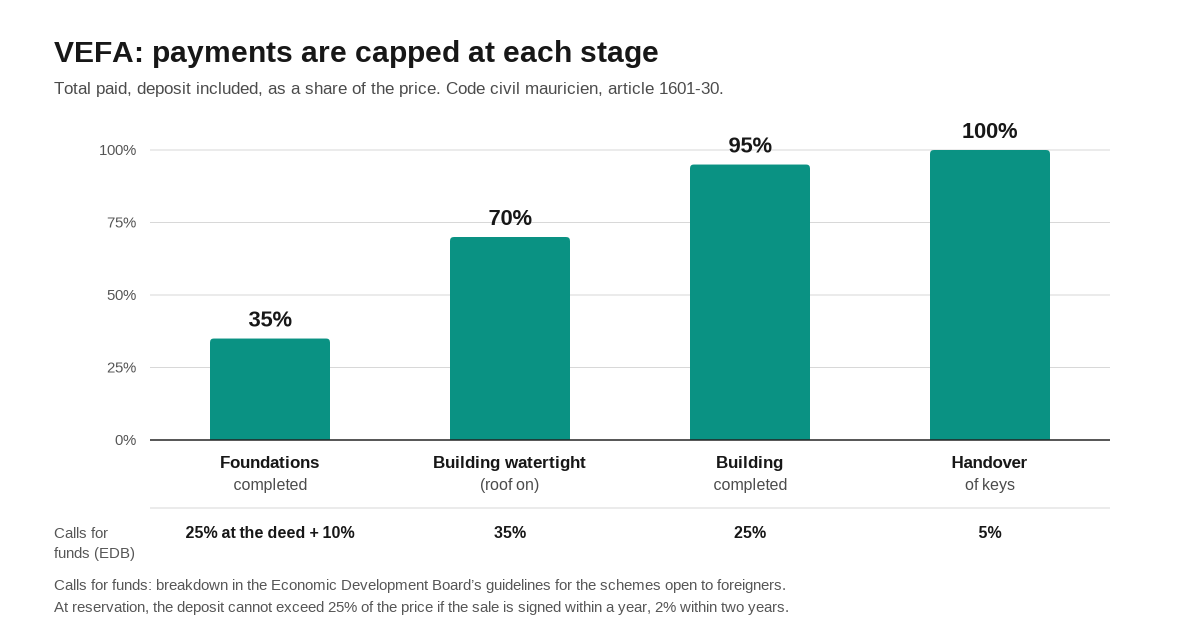
The Economic Development Board’s guidelines for the schemes open to foreigners split these ceilings into five calls for funds: 25% on signing the deed, 10% on completion of the foundations, 35% when the building is roofed in, 25% on completion and 5% on handover.
Four rules go with this schedule:
- completion of the foundations is certified by a building professional (article 1601-27): ask for the certificate before you pay;
- if the contract provides for a penalty when you pay late, it cannot exceed 1% a month;
- a clause that cancels the sale for non-payment only takes effect one month after a formal demand has gone unanswered (article 1601-10), and the fixed indemnity payable on cancellation cannot exceed 10% of the price (article 1601-11);
- the final 5% can be paid into escrow, instead of to the seller, if you dispute whether the property delivered conforms to the contract.
The completion guarantee: the question to ask
This is the central protection: what happens if the developer does not finish? A VEFA deed must contain one of these two guarantees.
The completion guarantee. It can take two very different forms (articles 1601-31 to 1601-34).
- A bank or financial institution commits itself. Either it opens a credit line and undertakes to advance the sums needed to finish the building, or it stands surety towards you, jointly with the seller. This is what is commonly called the garantie financière d’achèvement (GFA).
- The guarantee follows from the project itself. The law treats it as given if the building is already watertight and free of any mortgage, or if the foundations are completed and 75% of the planned sale price is financed by the developer’s own funds, the sales already signed and confirmed credit lines. That threshold falls to 60% if own funds cover 30% of the price. In this case, no institution commits itself to you.
When the guarantee follows from the project, the deed must state that you have been told so, and the seller must keep the evidence available to you at the notary’s office: a certificate from the notary on the sales already concluded, and a certificate from the bank on the credit lines and own funds (article 1601-33). Ask to see them.
The refund guarantee. A bank or financial institution stands surety and undertakes to refund your payments if the sale is cancelled because the building is not completed (article 1601-35).
In both cases the guarantee ends when the building is completed (article 1601-37). It is there to get the building finished or your money returned; defects fall under other warranties, described below.
For a foreigner buying an off-plan apartment in a G+2 building, the Economic Development Board asks for the building permit and a completion guarantee letter from a registered financial institution in the application file.
Delivery
In law, a building is completed when the works have been carried out and the equipment essential to its use has been installed (article 1601-13). Departures from the contract that are not substantial do not prevent completion. But recording completion is neither agreement that the property conforms, nor a waiver of your remedies.
On handover day, visit with the plans and the specification, write down everything that is missing or different, and keep a dated copy. If the disagreement is about conformity, the balance can be paid into escrow.
What if the developer delivers late? The chapter on off-plan sales sets no penalty for late delivery. Two consequences. Have a precise delivery date and a penalty per month of delay written into the deed. Failing that, the general rules of sale remain: if the delay is caused by the seller alone, the buyer may ask for the sale to be cancelled or to be put in possession, and for damages if they have suffered a loss (articles 1610 and 1611).
After handover: three warranties
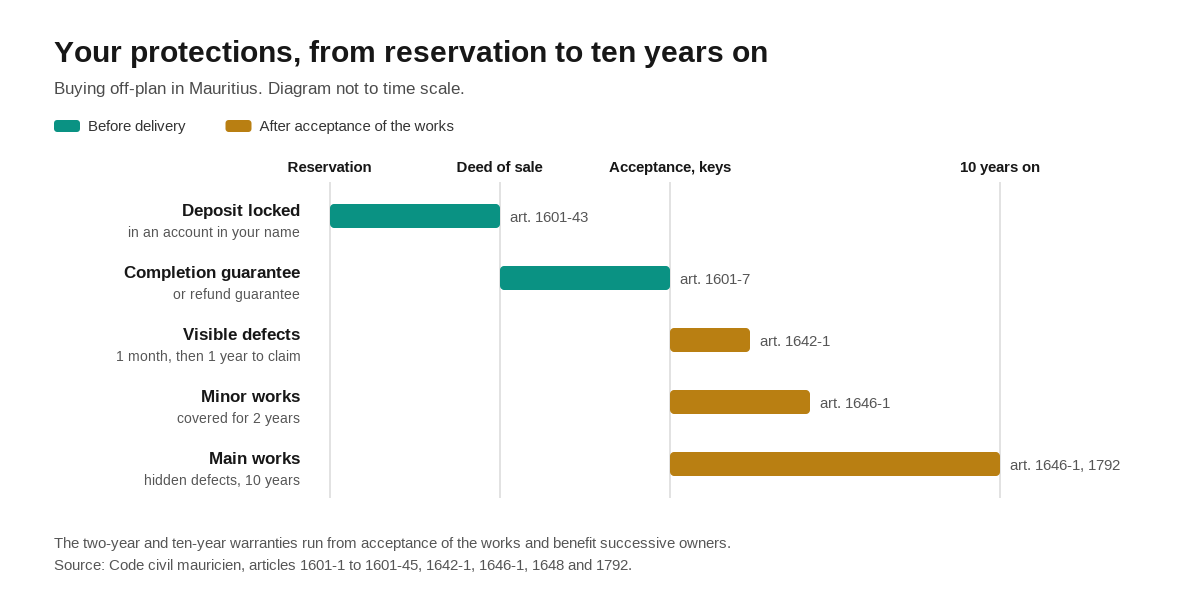
| What is covered | Duration | Text |
|---|---|---|
| Visible construction defects | The seller remains liable until the works are accepted and for one month after you take possession; you then have one year to bring a claim | Articles 1642-1 and 1648 |
| Minor works (menus ouvrages): doors, windows, shutters, pipework, radiators | 2 years from acceptance of the works | Articles 1646-1 and 1601-23 |
| Hidden defects in the main works (gros ouvrages): structure, roof, waterproofing, walls, floors, built-in pipework | 10 years from acceptance of the works | Articles 1646-1, 1792 and 1601-22 |
These warranties follow the property: they benefit successive owners. For visible defects, the seller can avoid cancellation or a price reduction by undertaking to repair. Mechanical or electrical appliances that the contractor installs as delivered to him are not "works" for the purposes of these warranties (article 1601-24).
In practice, send the list of visible defects in writing within the month after you move in, and keep proof that it was sent.
If you are a foreigner
A non-citizen buys off-plan in one of two settings: a scheme approved by the Economic Development Board (PDS, Smart City and, for older developments, IRS and RES), or an apartment in a building of at least two floors above the ground floor, from Rs 6 million. The two routes are compared in the guide for foreign buyers and the guide to the schemes.
Four rules then come on top of the Civil Code:
- The price comes from abroad. Since 13 December 2024, in the schemes, it is transferred in a convertible currency to the notary’s account, and the notary pays the developer. The route is described in the bank account guide.
- Residence. A property worth more than US$375,000 gives the right to a residence permit, valid for as long as you remain the owner. Under the EDB’s guidelines, it is acquired on payment of the registration duty.
- Registration duty. It is 5% for a first purchase in a PDS. For a first purchase in an IRS or a RES, it is US$70,000 or 5% of the value, whichever is lower.
- The agency. In an off-plan sale, the developer pays the agency.
In Noukaz’s November 2026 price report, properties in the schemes open to foreigners show a median asking price of Rs 67.6 million for houses and villas, across the island, and Rs 24.9 million for apartments in the Rivière Noire district.
What comes on top of the price
- Registration duty, 5% as a general rule, collected when the deed is registered: in a VEFA you therefore pay it at the start, not on delivery. See the guide to duties and taxes.
- The notary’s fees, set by a sliding scale, plus 15% VAT. See the notary fees guide.
- For a non-citizen, the EDB’s processing fee: Rs 25,000 per application in the schemes.
- If you borrow, the costs of the loan and the mortgage. See the home loan guide.
Ten checks before you sign
- The reservation deposit is paid into a special account in your name, at a bank or a notary’s office, never into the developer’s account.
- It does not exceed 25% of the price if the sale is signed within a year, or 2% if it is signed within two years.
- The reservation contract reproduces articles 1601-42 to 1601-45 and was given to you before any payment.
- You received the draft deed at least one month before signing, and a professional has read it for you.
- The deed says which guarantee protects you, completion or refund, and who gives it.
- If the guarantee follows from the project, you have seen the certificates at the notary’s office.
- The building permit has been issued.
- The price is fixed, or its revision formula is written down.
- The deed sets a delivery date and a penalty for delay.
- The dimensioned plans, the specification and the co-ownership rules are annexed, and the floor areas match what you were sold.
To choose the notary who will read the deed with you, see the list of notaries. The steps common to every purchase are in the buying guide.
Frequently asked questions
What is a VEFA in Mauritius?
The sale in the future state of completion (vente en l’état futur d’achèvement) is a contract under the Code civil mauricien (article 1601-3): you at once become the owner of the land and of what is built, then of the works as they are carried out, and you pay as the building progresses.
What deposit can I be asked for at reservation?
At most 25% of the forecast price if the sale is to be signed within a year, 2% if within two years, and nothing beyond that. The deposit is paid into a special account in your name, at a bank or a notary’s office.
How are the payments staged?
The law sets cumulative ceilings: 35% of the price when the foundations are completed, 70% when the building is watertight, 95% on completion, and the balance on handover.
Is the completion guarantee compulsory?
A VEFA deed must state a completion guarantee or a refund guarantee, or the sale is void. The completion guarantee may come from a bank, or follow from the financing of the project: check which one is in your deed.
What happens if the developer delivers late?
The law sets no automatic penalty: it has to be written into the deed. Failing that, if the delay is caused by the seller alone, the buyer may ask for cancellation of the sale or to be put in possession, and for damages.
What warranties do you have after delivery?
Visible defects can be raised up to one month after you take possession, with one year to bring a claim. Minor works are covered for two years and hidden defects in the main works for ten years, from acceptance of the works.
Can a foreigner buy off-plan in Mauritius?
Yes, in a scheme approved by the Economic Development Board or for an apartment in a G+2 building priced at Rs 6 million or more. In the schemes, the price is transferred from abroad to the notary’s account.
Looking for a property? Browse property for sale and read how to choose an estate agent.
Sources: Code civil mauricien, articles 1601-1 to 1601-45, 1610, 1611, 1642-1, 1646-1, 1648 and 1792 (Revised Laws of Mauritius, text published by the Registrar-General’s Department), read on 24 November 2026; Economic Development Board (guidelines for the IRS, RES and PDS schemes; guidelines on the acquisition of apartments by non-citizens; communiqué of 20 December 2024 on payment rules); Noukaz price report (November 2026).
General information, not legal advice. Have the reservation contract and the draft deed read by a notary before you sign.