
Guides
Cost of Living in Mauritius in 2026: Rent, Bills, School, Budgets
What does it cost to live in Mauritius? The answer comes down to two items, rent and school, plus a handful of bills whose price is set by the State. This guide prices them one by one, using the official tariffs in force in November 2026 and the rents asked in listings published on Noukaz.
We kept only prices that can be checked: a tariff, a public price, a median computed from listings. US dollar amounts are converted at the rate published by the Mauritius Revenue Authority for the week of 23 to 29 November 2026: US$1 = Rs 48.54.

The essentials in one table
| Item | Price in November 2026 | In US dollars (about) |
|---|---|---|
| Median asking rent, apartment | Rs 65,000 a month | $1,340 |
| Median asking rent, house | Rs 114,088 a month | $2,350 |
| Electricity, 300 kWh | Rs 2,075 a month | $43 |
| Electricity, 500 kWh | Rs 4,481 a month | $92 |
| Water, 20 m³ | Rs 140 a month | $2.90 |
| Cooking gas, 12 kg cylinder | Rs 250 | $5.15 |
| Fibre internet, 100 Mbps | Rs 1,200 a month | $25 |
| Petrol | Rs 77.70 a litre | $1.60 |
| French school, primary | Rs 191,175 a year | $3,940 |
| Minimum wage | Rs 17,745 a month | $365 |
Two ways to read this table. Regulated prices, such as water and gas, are low. Housing and school decide the rest.
Housing, the biggest item
Noukaz’s November 2026 price report gives the median rent asked for a long-term let: half of the listings ask more, half ask less.
| Where | Apartment | House |
|---|---|---|
| Mauritius | Rs 65,000 | Rs 114,088 |
| Rivière Noire (west coast) | Rs 67,500 | Rs 128,596 |
| Plaines Wilhems (central plateau) | Rs 50,000 | Rs 85,000 |
| Moka | Rs 50,000 | – |
| Pamplemousses (north-west) | – | Rs 65,000 |
A dash means we do not publish a figure. A median is only given from five listings, placed by at least three different advertisers, none of whom accounts for more than half of the total.
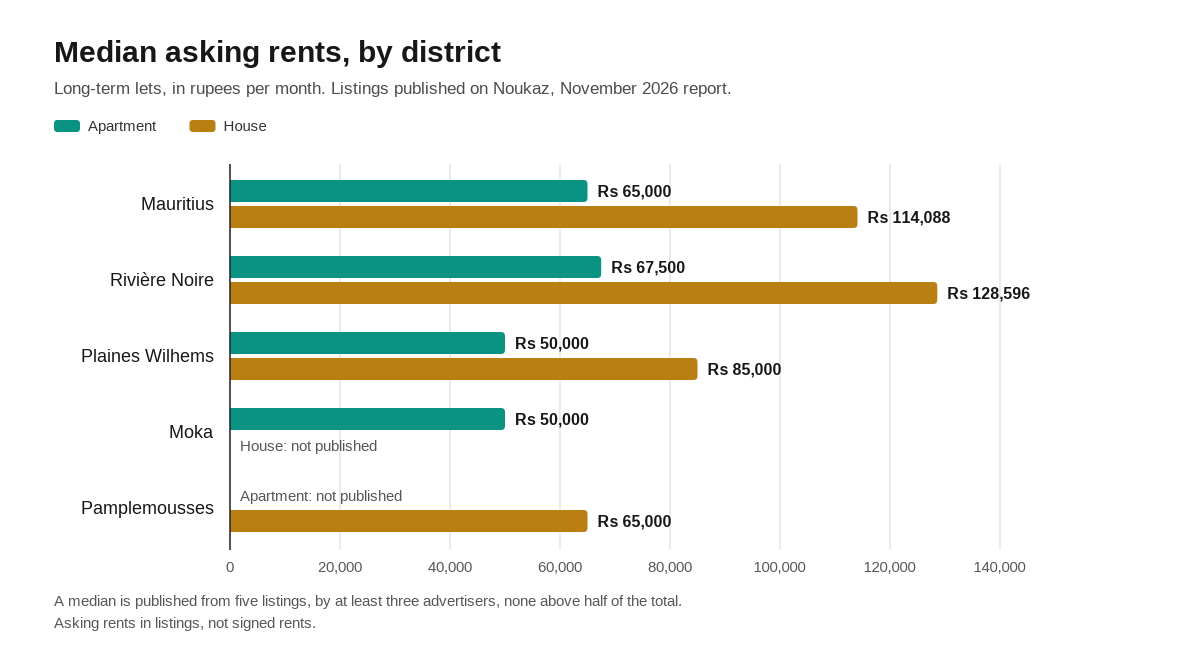
The spread inside each category is wide. For apartments, half of the listings fall between Rs 40,000 and Rs 92,011 a month: one apartment in four is therefore offered below Rs 40,000, about $825. For houses, half of the listings run from Rs 60,000 to Rs 179,205.
Three points before you build a budget on these figures:
- These are asking rents, not signed rents. The final figure is usually a little lower.
- They describe the listings published on Noukaz, not the island’s whole rental market. Homes let without a listing are not in them.
- On moving in, allow for the deposit, one to three months' rent, and the agency fee if you use an agency: since 1 August 2026 it has been capped at 8% of twelve months' rent for each party, a little under one month, plus 15% VAT.
Lease rules, deposits and the checks to make are in our guide to long-term rentals. Current listings are under property for rent.
Electricity, water, gas, internet
These four bills have one thing in common: their price is public.
Electricity is billed in bands. The more you use in a month, the more each kilowatt-hour costs. Under the Central Electricity Board (CEB) tariff in force since 1 May 2026, the first 25 kWh cost Rs 3.63 each; above 300 kWh, each kWh costs at least Rs 12.03. The CEB’s bill calculator gives, before meter rent and other charges:
- 300 kWh in a month: Rs 2,075, about $43;
- 500 kWh in a month: Rs 4,481, about $92.
The last 200 kWh therefore cost more than the first 300, and air conditioning takes you quickly from one figure to the other. This tariff was raised by 15% on 1 May 2026 for most customers.
Water is the lightest item. The Central Water Authority charges Rs 45 a month for up to 10 m³. Above that, the tariff rises in bands: Rs 6 per m³ for the first ten, Rs 8 from 11 to 20 m³, Rs 17 from 21 to 50 m³, Rs 32 beyond. Using 20 m³ comes to Rs 140; using 30 m³ comes to Rs 310. A customer with a swimming pool who uses more than 50 m³ a month also pays a Rs 500 fee.
Cooking gas has a fixed price. The 12 kg cylinder has cost Rs 250 since 28 March 2026 and the 6 kg cylinder Rs 125, according to the State Trading Corporation.
Internet. At Mauritius Telecom, fibre with no other service costs Rs 499 a month for 20 Mbps, Rs 1,200 for 100 Mbps and Rs 4,700 for 1 Gbps, VAT included.
Fuel and transport
Pump prices are the same across the island: they are set by a public body, the Petroleum Pricing Committee. Since 29 September 2026, a litre of petrol has cost Rs 77.70 (about $1.60) and a litre of diesel Rs 78.35 (about $1.61).
This is the item that moved most in 2026. In mid-April petrol was still at Rs 58.45: it rose 33% in under six months, in three increases. Diesel has followed the same slope since March.
If you live on the central plateau, the Metro Express links Port Louis to Curepipe through Rose Hill, Quatre Bornes and Vacoas, and can replace some car journeys. Elsewhere, factor the daily commute, and its fuel cost, into your choice of area.
Groceries and inflation
Two staples are sold at a price set by the State: ration rice, at Rs 5.40 per half kilo, and white flour, at Rs 4.85 per half kilo.
For everything else, we do not publish supermarket prices: they vary from one chain to another, and there is no public product-by-product survey. Statistics Mauritius’s price index does show which way things are going. In October 2026, consumer prices were 6.4% higher than a year earlier, against 4.1% in October 2025. Over twelve rolling months, average inflation is 4.3%.
The index is calculated on a base of 100 in 2023. It shows what has risen most since then:
| Index division | Index, October 2026 | Since 2023 |
|---|---|---|
| Restaurants and accommodation | 129.3 | + 29.3% |
| Health | 119.7 | + 19.7% |
| Education | 119.0 | + 19.0% |
| Transport | 115.4 | + 15.4% |
| Food and non-alcoholic beverages | 114.7 | + 14.7% |
| Housing, water, electricity, gas | 109.9 | + 9.9% |
| Information and communication | 99.5 | – 0.5% |
| All items | 114.8 | + 14.8% |
Restaurants and accommodation have therefore risen twice as fast as food. In response to this inflation, the Bank of Mauritius raised its Key Rate to 5% on 11 November 2026. Its inflation target runs from 2% to 5%.
School and health
French school is the second big item for an expatriate family. At École du Nord in Mapou, a school under agreement with the French agency for education abroad (AEFE), primary costs Rs 191,175 a year in 2026-2027 for French and Mauritian families, about $3,940, and Rs 224,600 for other nationalities. The school lets you pay in eleven instalments, about Rs 17,380 a month per child.
At Lycée des Mascareignes, tuition for 2026-2027 is Rs 234,410 a year for a French or Mauritian pupil in the standard stream, about $4,830. A new pupil also pays a Rs 100,000 first enrolment fee, unless they come from École du Nord or École du Centre.
For two children in primary, tuition therefore comes to Rs 382,350 a year, about $7,875.
Health care runs on two tiers. The public system is free at the point of use. Most expatriates also carry private insurance for the clinics, and the Premium Visa requires travel and health insurance in any case. Permits and their conditions are set out in our guide to moving to Mauritius.
Wages and tax: two reference points
The national minimum wage has been Rs 17,745 a month for full-time work since 1 January 2026, about $365. The median rent of an apartment in our listings is more than three and a half times that wage. The medians in this guide therefore describe the homes advertised on a portal, not the everyday housing of a Mauritian household.
The other reference point comes from permits. For a Premium Visa, the State asks for an income of at least US$1,500 a month, about Rs 72,800: roughly the median rent in our listings, houses and apartments together (Rs 75,000).
On tax, the income tax scale leaves the first Rs 500,000 of chargeable income in the year untaxed. The next band, up to Rs 1 million, is taxed at 10%, then the rate rises to 20%. Since the income year that began on 1 July 2026, a 35% band applies above Rs 12 million.
Three sample budgets
Here are three examples, built only from the items priced above: median asking rent, electricity, water, one gas cylinder, 100 Mbps fibre, petrol and, for the family, tuition spread over twelve months.
| Couple, apartment on the central plateau | Family, two children at École du Nord, house in Pamplemousses | Couple, house on the west coast | |
|---|---|---|---|
| Median asking rent | Rs 50,000 | Rs 65,000 | Rs 128,596 |
| Electricity | Rs 2,075 (300 kWh) | Rs 4,481 (500 kWh) | Rs 4,481 (500 kWh) |
| Water | Rs 100 (15 m³) | Rs 310 (30 m³) | Rs 310 (30 m³) |
| Gas, internet | Rs 1,450 | Rs 1,450 | Rs 1,450 |
| Petrol | Rs 4,662 (60 litres) | Rs 9,324 (120 litres) | Rs 9,324 (120 litres) |
| Tuition | – | Rs 31,863 | – |
| Total per month | Rs 58,287 | Rs 112,428 | Rs 144,161 |
| In US dollars (about) | $1,200 | $2,315 | $2,970 |
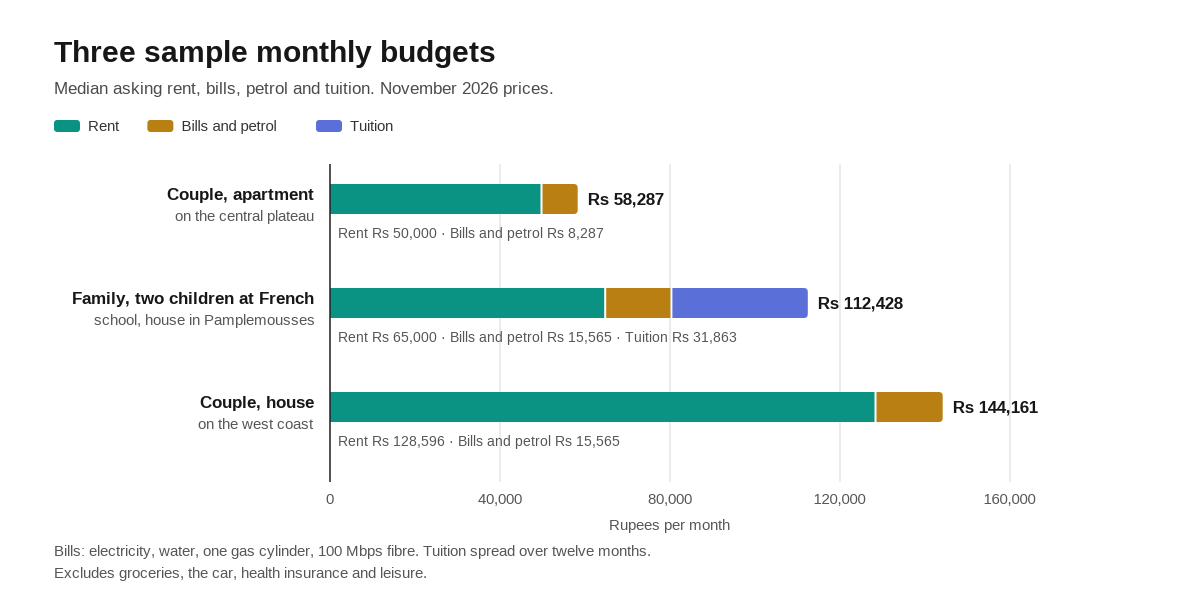
These totals leave out groceries, the car itself, health insurance and leisure. They show what weighs most: in all three cases rent is more than half of the total, and choosing the central plateau over the west coast changes the budget more than all the bills put together.
Buying instead of renting?
The question comes up quickly once rent passes Rs 60,000 a month. In our November 2026 listings, the median asking price is Rs 7.7 million for an apartment and Rs 11.2 million for a house in Plaines Wilhems, and Rs 29.9 million for an apartment in the Rivière Noire district. Prices by district are in our property price report.
Two things to know before you compare a rent with a loan repayment. A purchase adds 5% registration duty and the notary’s fees, detailed in the buying guide. And a foreigner cannot buy just any property: the guide for foreign buyers explains what is open to them. For borrowing, see the home loan guide.
Frequently asked questions
How much do you need to live in Mauritius?
With a median rent, the bills and petrol, allow about Rs 58,000 a month ($1,200) for a couple in an apartment on the central plateau, and about Rs 144,000 ($2,970) for a couple in a house on the west coast, before groceries, the car, health care and leisure. A family with two children at French school adds about Rs 32,000 a month in tuition.
What is the average rent in Mauritius?
In the listings published on Noukaz in November 2026, the median asking rent is Rs 65,000 a month for an apartment and Rs 114,088 for a house. One apartment in four is offered below Rs 40,000.
How much does electricity cost in Mauritius?
The price rises with consumption. According to the Central Electricity Board’s calculator, 300 kWh cost Rs 2,075 in a month and 500 kWh cost Rs 4,481, before meter rent and other charges.
What is the price of petrol in Mauritius?
Rs 77.70 a litre for petrol and Rs 78.35 for diesel since 29 September 2026, everywhere on the island. In mid-April 2026 petrol cost Rs 58.45.
What is the minimum wage in Mauritius?
Rs 17,745 a month for full-time work since 1 January 2026, about $365.
Can you live in Mauritius on $1,500 a month?
$1,500 is about Rs 72,800. That covers the first sample budget in this guide, a couple in an apartment on the central plateau (Rs 58,287 in rent, bills and petrol), and leaves about Rs 14,500 for groceries, health care and everything else. It is not enough to rent a house at the median rent on the west coast.
Is the cost of living rising in Mauritius?
Yes. In October 2026, consumer prices were 6.4% higher than a year earlier according to Statistics Mauritius, and petrol rose 33% between April and September 2026.
Planning your move? See property for rent, how to open a bank account and property prices compared with France.
Sources: Noukaz price report (November 2026, listings online on 24 November); Central Electricity Board (tariff of 1 May 2026, bill calculator); Central Water Authority (domestic tariffs); State Trading Corporation (fuel prices at 29 September 2026, gas, rice, flour); Mauritius Telecom (fibre plans); Statistics Mauritius (consumer price index, October 2026); Bank of Mauritius (decision of 11 November 2026); École du Nord and Lycée des Mascareignes (2026-2027 fees); national minimum wage regulations (Government Gazette of 17 January 2026); Finance Act 2026; Mauritius Revenue Authority (exchange rates for the week of 23 to 29 November 2026).
General information. Public tariffs change: check them with each body before you settle a budget.